
Circuit and electronics kits, explained
Battery kits, plug-in toys, and the rules CPSC points to.
Disclosure: We may earn a commission if you buy through links on this page. It does not change our guidance. Affiliate Disclosure
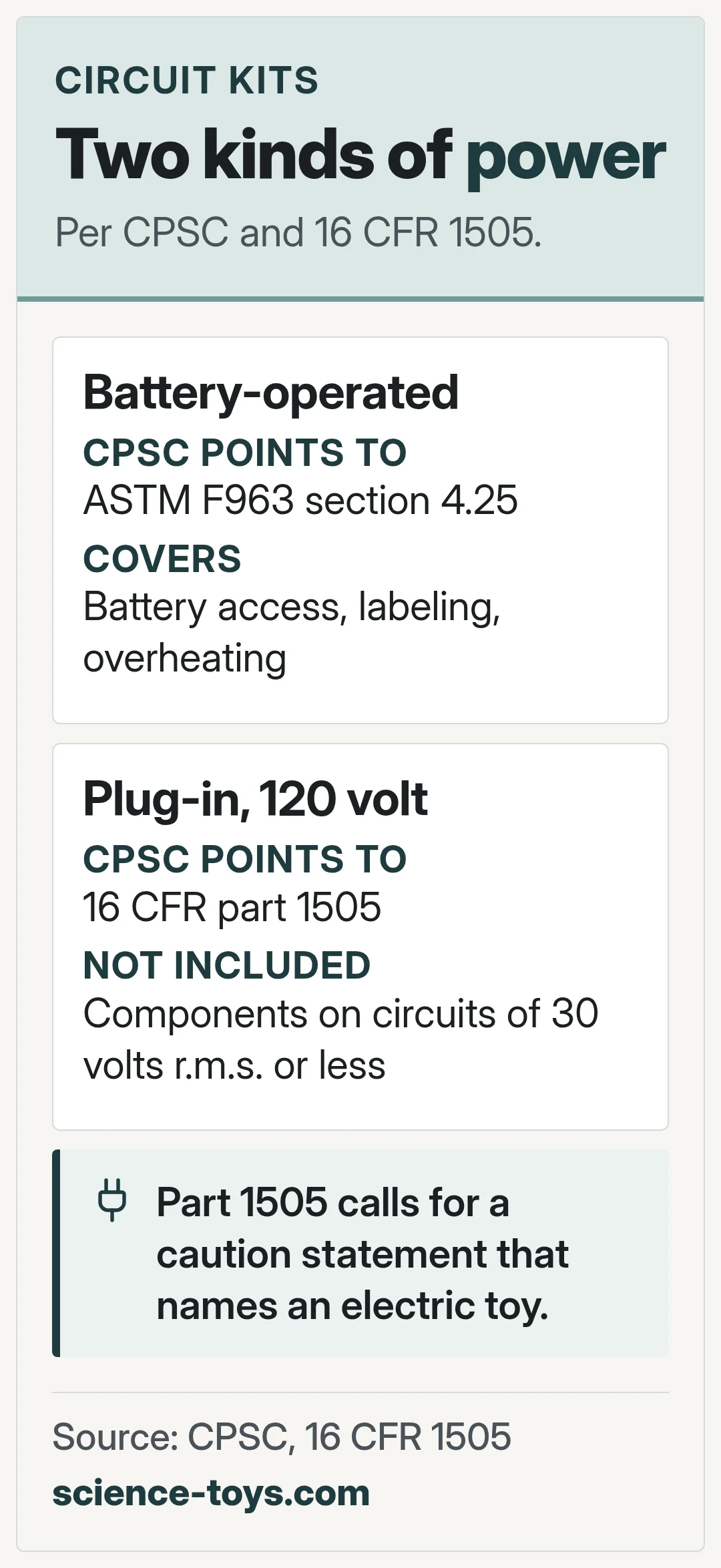
Two kinds of power
Circuit and electronics kits run on batteries, or they plug into a wall outlet. The package and the manual say which.
Battery-operated toys
CPSC says ASTM F963 section 4.25 covers battery-operated toys, and that its requirements include "preventing children from accessing the battery during play time, labeling, and ensuring the battery does not overheat."
Plug-in electric toys
CPSC says requirements for electrically operated toys are at 16 CFR part 1505. Part 1505 covers toys "intended to be powered by electrical current from nominal 120 volt (110-125 v.) branch circuits," and its definition does not include components "powered by circuits of 30 volts r.m.s. (42.4 volts peak) or less."
The caution statement
Part 1505 calls for a caution statement on these toys and their packages that names them as electric toys and gives an age the maker fills in. It says that "in no instance shall the manufacturer indicate that the article is recommended for children under 8 years of age if it contains a heating element."
Coin cells in small devices
Some kits use button or coin batteries. CPSC says to keep button or coin batteries away from young children. Our button battery guide covers Reese's Law.
This is general information, not legal advice.
Sources: CPSC, Toy Safety Business Guidance; eCFR, 16 CFR Part 1505, Electrically Operated Toys; CPSC news release, CPSC Reminds Early Holiday Shoppers to Follow These Top Safety Tips (October 18, 2022); CPSC, Recalls & Product Safety Warnings.
FAQ
General information only, for adults choosing toys for children. We do not test, certify, or rate any product, and we do not say any toy or kit is safe or right for a particular child or age. Before you buy or use one, read the maker's age grade, warnings, and instructions, follow any adult supervision directions, and check for recalls at cpsc.gov/Recalls. Keep small parts, magnets, button and coin batteries, and kit chemicals away from young children. A swallowed magnet, button battery, or coin battery needs medical help right away; do not delay. If you think a child swallowed or touched something harmful, call Poison Help at 1-800-222-1222. In an emergency, call 911.


Next: button batteries
Swallowed? Get help now.
