
What STEM toys and science kits are
Kit types in plain words, and what to read on the box.
Disclosure: We may earn a commission if you buy through links on this page. It does not change our guidance. Affiliate Disclosure
What STEM means
STEM stands for science, technology, engineering, and math. A STEM toy or science kit is a toy or set built around one of those subjects. The words on the box are the maker's description, not a rating.
The kit types we cover
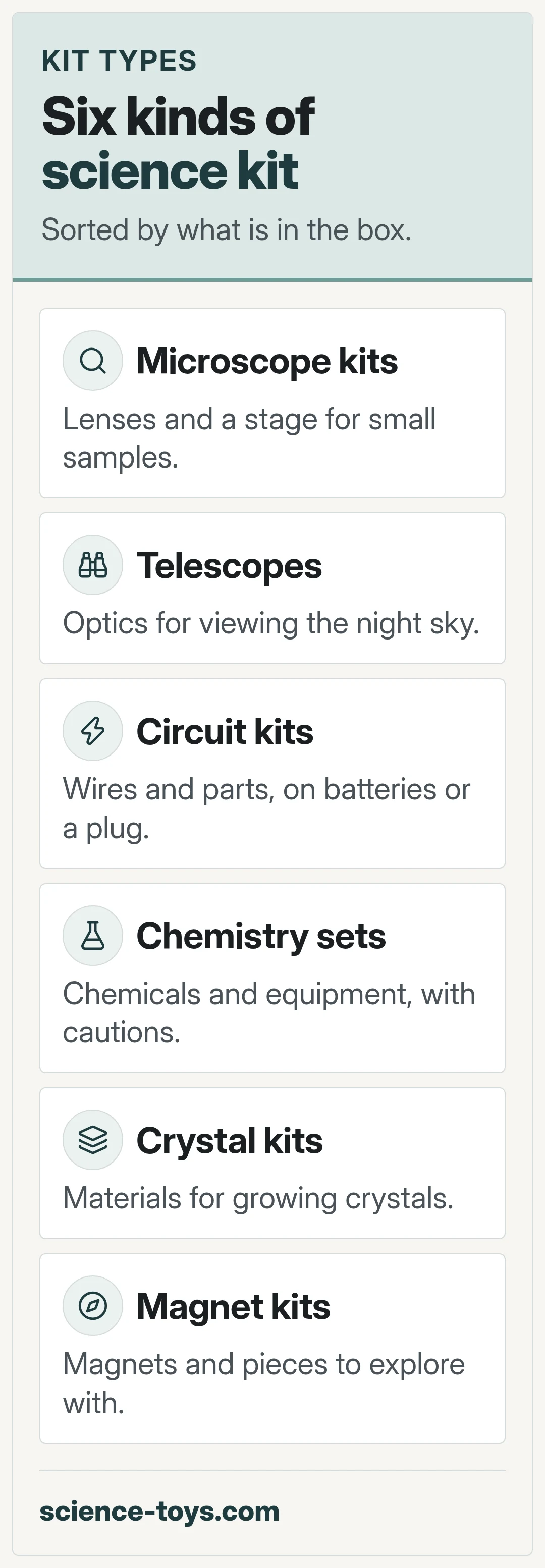
We sort science kits by what is in the box: microscope kits, telescopes, circuit and electricity kits, chemistry sets, crystal growing kits, and magnet kits. Each type has a guide on this site, with the federal rules CPSC describes for it.
When a science kit is a toy
CPSC defines a toy as any object "designed, manufactured, or marketed as a plaything for children under 14 years of age," and lists exclusions. CPSC says section 106 of the CPSIA "made ASTM F963 a mandatory consumer product safety standard for children's toys."
Read the box first
CPSC says to follow the age guidance and other safety information on a toy's packaging. The age grade and warnings are the maker's statements. Read them, with the instructions, before a child uses the kit. Check for recalls at cpsc.gov/Recalls before you buy or use one.
Learning claims
We do not say any toy or kit teaches a skill or changes results at school. A learning claim on a package is the maker's claim, not ours.
This is general information, not legal advice.
Sources: CPSC, Toy Safety Business Guidance; CPSC, Toys (Safety Education Center); CPSC, Recalls & Product Safety Warnings.
FAQ
General information only, for adults choosing toys for children. We do not test, certify, or rate any product, and we do not say any toy or kit is safe or right for a particular child or age. Before you buy or use one, read the maker's age grade, warnings, and instructions, follow any adult supervision directions, and check for recalls at cpsc.gov/Recalls. Keep small parts, magnets, button and coin batteries, and kit chemicals away from young children. A swallowed magnet, button battery, or coin battery needs medical help right away; do not delay. If you think a child swallowed or touched something harmful, call Poison Help at 1-800-222-1222. In an emergency, call 911.
Next: chemistry sets
Cautions first, then the kit.
