

ASTM F963, the toy standard, explained
What CPSC says the standard covers, and how it became federal law.
Disclosure: We may earn a commission if you buy through links on this page. It does not change our guidance. Affiliate Disclosure
What it is
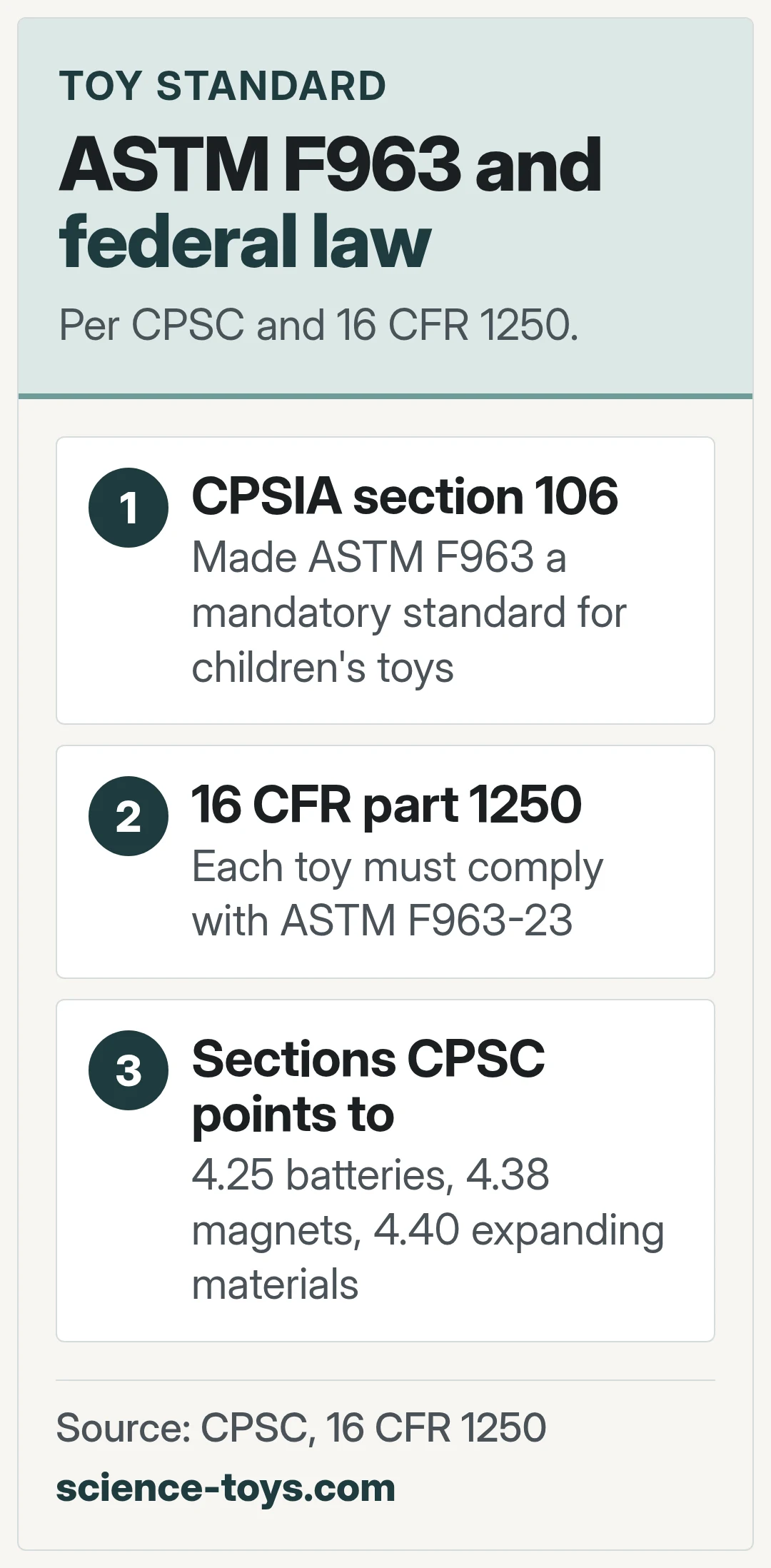
ASTM F963 is a toy standard published by ASTM International. CPSC says section 106 of the CPSIA "made ASTM F963 a mandatory consumer product safety standard for children's toys."
Where the rule lives
16 CFR 1250.2(a) says: "Each toy must comply with all applicable provisions of ASTM F963-23." CPSC lists ASTM F963-23 for toys manufactured after April 20, 2024.
What counts as a toy
CPSC says a toy is any object "designed, manufactured, or marketed as a plaything for children under 14 years of age," and lists exclusions.
Sections CPSC points to
CPSC's toy safety guidance describes F963 sections, including 4.25 for battery-operated toys, 4.38 for magnets, and 4.40 for expanding materials, "such as those that absorb water and get bigger." CPSC says requirements for electrically operated toys are at 16 CFR part 1505.
Testing and certificates
CPSC says its testing and certification requirements "only apply to products designed or intended primarily for children 12 years of age or younger." Our certificate guide explains the Children's Product Certificate.
This is general information, not legal advice.
Sources: CPSC, Toy Safety Business Guidance; eCFR, 16 CFR Part 1250, Safety Standard Mandating ASTM F963 for Toys; eCFR, 16 CFR Part 1505, Electrically Operated Toys.
FAQ
General information only, for adults choosing toys for children. We do not test, certify, or rate any product, and we do not say any toy or kit is safe or right for a particular child or age. Before you buy or use one, read the maker's age grade, warnings, and instructions, follow any adult supervision directions, and check for recalls at cpsc.gov/Recalls. Keep small parts, magnets, button and coin batteries, and kit chemicals away from young children. A swallowed magnet, button battery, or coin battery needs medical help right away; do not delay. If you think a child swallowed or touched something harmful, call Poison Help at 1-800-222-1222. In an emergency, call 911.

Next: certificates
Who issues it, how to ask.
