
Telescopes and the Sun: what NASA says
Why a solar filter goes on the front, and why eclipse glasses are not one.
Disclosure: We may earn a commission if you buy through links on this page. It does not change our guidance. Affiliate Disclosure
The rule NASA states plainly
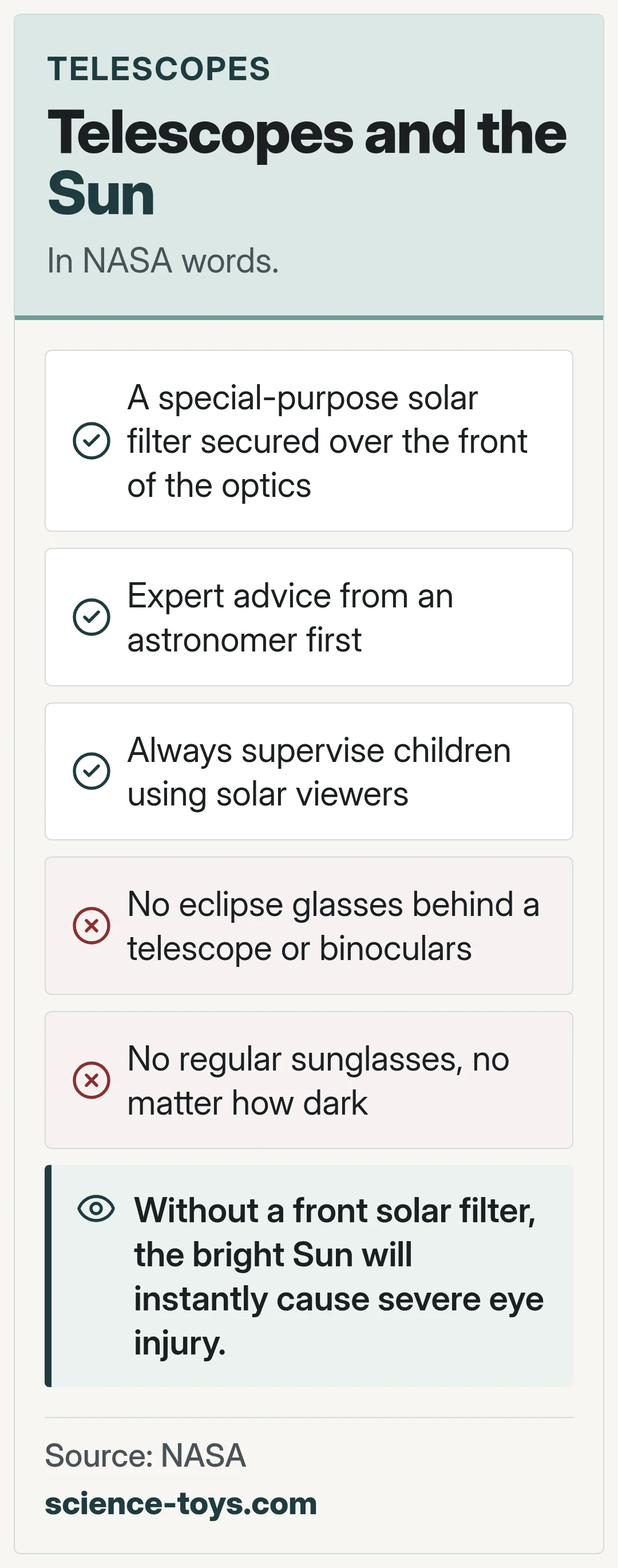
NASA says: "Viewing any part of the bright Sun through a camera lens, binoculars, or a telescope without a special-purpose solar filter secured over the front of the optics will instantly cause severe eye injury."
Eclipse glasses are not a telescope filter
NASA says not to look at the Sun through a camera lens, telescope, binoculars, or other optical device while wearing eclipse glasses or using a handheld solar viewer. It says "the concentrated solar rays will burn through the filter and cause serious eye injury."
Sunglasses
NASA says "regular sunglasses, no matter how dark, are not safe for viewing the Sun."
Where a solar filter goes
NASA says "solar filters must be attached to the front of any telescope, binoculars, camera lens, or other optics." It says to "Seek expert advice from an astronomer before using a solar filter with a camera, telescope, binoculars, or any other optical device."
Children and solar viewers
NASA says: "Always supervise children using solar viewers." The maker's manual covers setting up and pointing its telescope; we do not give usage steps.
This is general information, not legal advice.
Sources: NASA Science, Eclipse Viewing Safety; CPSC, Recalls & Product Safety Warnings.
FAQ
General information only, for adults choosing toys for children. We do not test, certify, or rate any product, and we do not say any toy or kit is safe or right for a particular child or age. Before you buy or use one, read the maker's age grade, warnings, and instructions, follow any adult supervision directions, and check for recalls at cpsc.gov/Recalls. Keep small parts, magnets, button and coin batteries, and kit chemicals away from young children. A swallowed magnet, button battery, or coin battery needs medical help right away; do not delay. If you think a child swallowed or touched something harmful, call Poison Help at 1-800-222-1222. In an emergency, call 911.
Next: microscope kits
Eyepiece, stage, and focus.
