
Small parts and choking hazards, explained
What CPSC counts as a small part, and why the rule names children under 3.
Disclosure: We may earn a commission if you buy through links on this page. It does not change our guidance. Affiliate Disclosure
Why small parts matter
CPSC says: "The majority of toy injuries and deaths are associated with choking on small parts of toys."
What the ban covers
CPSC says toys and other articles intended for children under 3 that present a choking, aspiration, or ingestion hazard because of small parts are banned hazardous substances. CPSC says the small parts ban is at 16 CFR part 1501.
What CPSC counts as a small part
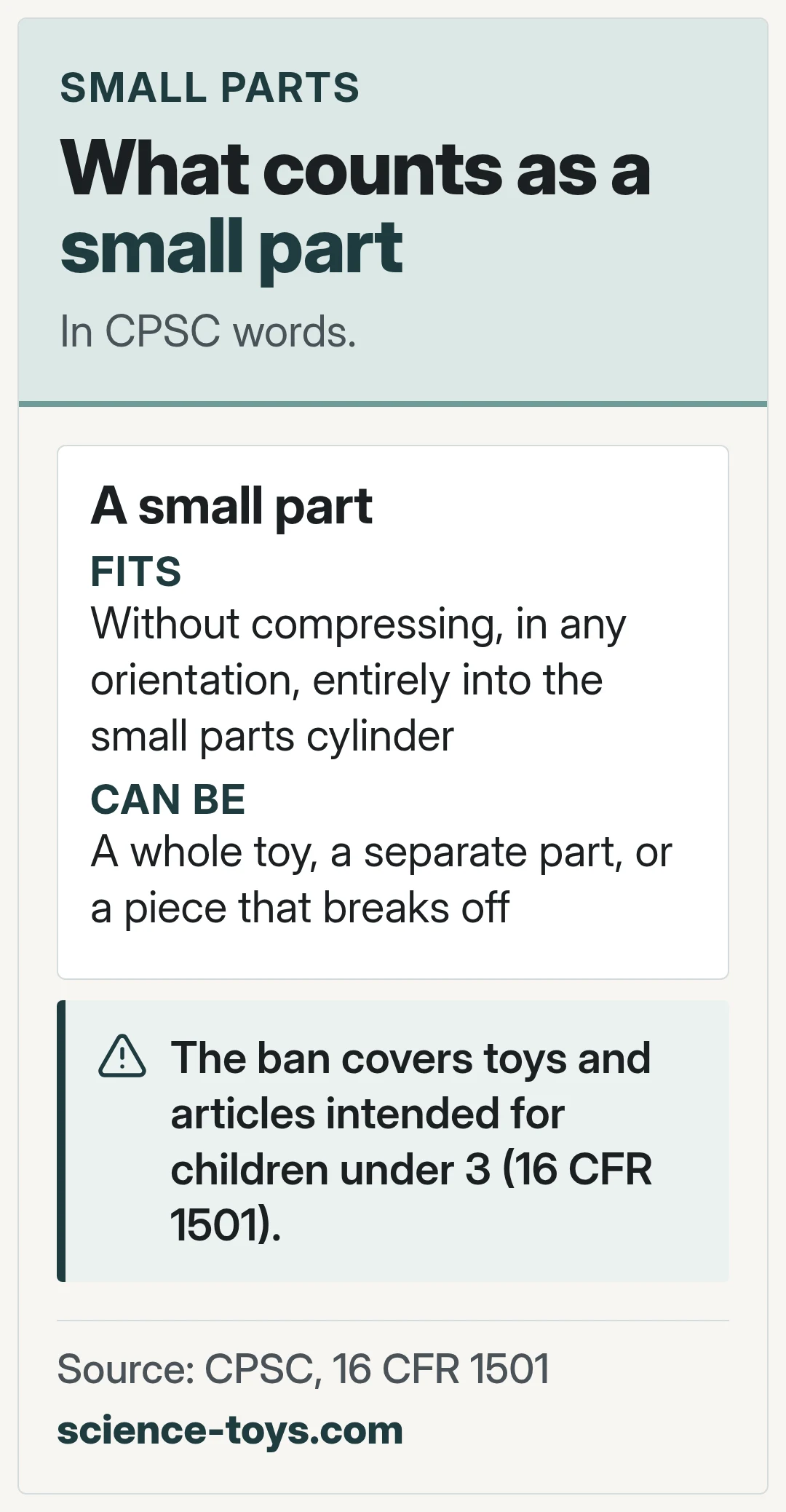
CPSC says a small part is any object that "fits, without compressing and in any orientation, entirely into the small parts cylinder," which "approximates the size of the fully expanded throat of a child under three years old." CPSC says a small part can be a whole toy, a separate part, or a piece that breaks off.
Small balls
CPSC's Child Safety Protection Act fact sheet says a ball with a diameter of 1.75 inches (44.4 mm) or less intended for children younger than 3 is banned, and that such balls intended for older children must carry a warning.
No home test here
The cylinder is a test tool defined in the rule. We do not describe a home test, and we do not say any household object can stand in for it. Read the maker's age grade and warnings instead.
In a science kit
Read the maker's warnings on any kit with small pieces, such as slides, magnets, or crystals. CPSC says to keep small balls and toys with small parts away from children younger than 3, and to consider the ages of all children in the home.
This is general information, not legal advice.
Sources: CPSC, Small Parts Ban and Choking Hazard Labeling; eCFR, 16 CFR Part 1501, Small Parts; CPSC news release, CPSC Reminds Early Holiday Shoppers to Follow These Top Safety Tips (October 18, 2022); CPSC, Toys (Safety Education Center); CPSC, Child Safety Protection Act Fact Sheet (PDF).
FAQ
General information only, for adults choosing toys for children. We do not test, certify, or rate any product, and we do not say any toy or kit is safe or right for a particular child or age. Before you buy or use one, read the maker's age grade, warnings, and instructions, follow any adult supervision directions, and check for recalls at cpsc.gov/Recalls. Keep small parts, magnets, button and coin batteries, and kit chemicals away from young children. A swallowed magnet, button battery, or coin battery needs medical help right away; do not delay. If you think a child swallowed or touched something harmful, call Poison Help at 1-800-222-1222. In an emergency, call 911.
Next: warning labels
Which toys carry a warning.
